
你平常喜歡做什麼?
What do you usually like to do?
Teaching Sample: Mandarin Leisure & Activities
Class Level: Beginner (Adult Learners)
Institution: Taiwan Center, New York (TCML)
Curriculum: 來!學華語(第一冊)
Let's Learn Mandarin (Book 1)
Instructional Unit: Lesson 6 "What do you usually like to do?"
Topic: Leisure Activities
Key Learning Objectives
By the end of this session, students will be able to:
-
List common hobbies and recreational activities.
-
Inquire about the interests of others using target sentence structures.
-
Express and discuss personal likes and dislikes.
-
Describe their daily activity patterns.
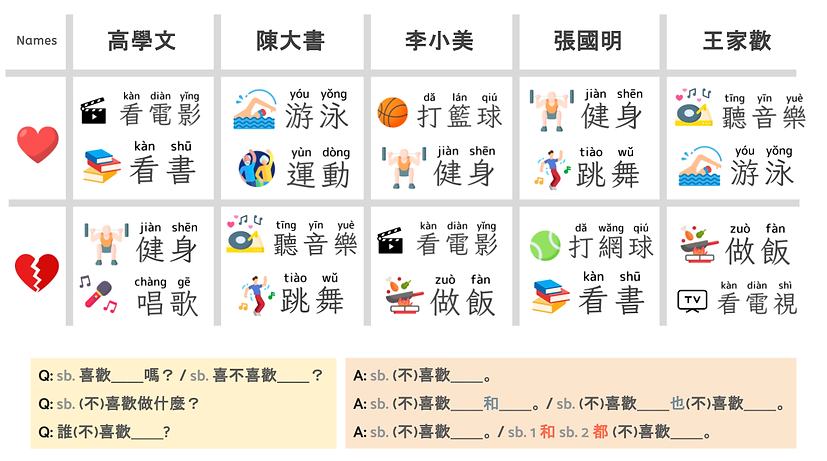
01. Integrated Vocabulary & Grammar Drill
To arouse students' curiosity and interests in learning this target lesson, I initiate the lesson by merging new vocabulary with target sentence structures through interactive drills. Instead of isolated memorization, students immediately use new words (hobbies) to answer and ask questions, transitioning from receptive knowledge to active oral production. Meanwhile, students learn how to use the target structures to ask for others' hobbies.

02. Structural Clarity
After briefly talking about the target structure, I give deeper explanations of the target patterns, including mentioning the common mistakes that learners would make. To support adult learners who value logical frameworks, I provide clear visual scaffolding for grammar. By using color-coding and comparative layouts, I demystify complex particles and sentence patterns, ensuring students understand the "why" behind the "what."


03. Authentic Discourse (也 vs. 還)
While this lesson includes "也" and "還," which sometimes confuse Mandarin learners, I utilize authentic linguistic data—such as my own real-life text messages and social media snapshots—to demonstrate the nuanced differences between them. This exposes students to native-speed Mandarin and real-world usage early in their learning journey. At the same time, students would feel a sense of achievement while they were "decoding" native speakers' texts with their own linguistic and literacy competence.

04. Structural Clarity
To further reinforce learners' understanding and memorization of a certain pattern, I provide many sample sentences to "quench their thirst." As adult learners tend to benefit from organized input, I use consistent color-coding (Subject/Time/Place/Verb) to help students internalize the Chinese word order. This "visual grammar" reduces cognitive load and empowers students to self-correct during spontaneous speech.

05. 5W1H Questions -- "Empowering Inquiry"
While we have learned some wh- words (e.g., where, who, what), it is important for a teacher to consolidate and organize the common pitfalls into a structured 5W1H matrix. By organizing interrogative forms around a single familiar context, I help students build a robust framework for initiating conversations and navigating daily interactions in Mandarin and beyond. After showing this sample sentence, I give students another sample sentence to make the 5W1H questions, implementing the P-P-P module (i.e., presentation, practice, and production). Lastly, I asked students questions and had them answer the open-ended questions based on their own situations.


06. Purposeful Listening
Rather than just reading the text, I treat the dialogue as a listening challenge. Students must listen to the conversation and complete a comprehension chart (Likes vs. Dislikes). This transforms a passive exercise into an active "information-gap" task, sharpening their auditory processing skills. The listening practice usually takes 3+ rounds to complete.
-
The 1st time: Students work on their own to take some notes.
-
The 2nd time: Students work on their own again to add more details to their answers.
/ Students check and discuss their answers with their teammates./ -
The 3rd time: Students have a different version of answers and listen to the audio one more time while fine-tuning their answers.
-
The 4th time: The teacher leads the conversation by playing and pausing the audio clip when needed without showing the script. Check the students' answers together as a whole group.

07. Synthesizing Competence
Unlike the traditional language teaching procedure, my lesson concludes with a deep dive into the textbook dialogue. Having already mastered the vocabulary and structures through drills and listening tasks, students approach the text with high confidence, ready to apply these patterns to their own lives.